Stepping outside your comfort zone: what if the problem wasn't comfort?
What the expression can make us forget: the suffering hidden behind the immobility
"You have to step out of your comfort zone." "She stays in her comfort zone." "He's afraid to move."
These phrases circulate everywhere—at work, in families, in support services, in everyday language. They convey a simple idea: if someone doesn't change a situation that seems to be harming them, it's because, deep down, they prefer the comfort of what they already know. Yet, a person who stays in a job that hurts them or in a relationship that wounds them isn't necessarily staying because they feel good there: they may simply be holding on in a situation that overwhelms them.
But there is one question that deserves to be asked before going any further: is the person we are talking about really comfortable?

A borrowed word, not a clinical concept
The expression "comfort zone" originated in the world of management and organizational performance, where it referred to a state in which a person functions stably, without any particular sense of risk. It is not a diagnosis or a concept validated in clinical psychology—it is a management metaphor that has since become a common term for almost any form of stagnation.
The problem isn't the metaphor itself. It lies in what it leads us to believe: that we directly see a person's comfort. In reality, we never see their comfort. We see their behavior—they stay, they don't act, they don't change anything—and then we assign meaning to it, often without verifying whether it's correct.
Staying is not the same as being well
A person might stay in a job that drains them, a relationship that hurts them, a burdensome isolation, or habits that no longer serve them well—not because they feel comfortable there, but because they know it. They know its limitations, its pitfalls, how to survive it day to day. The unknown, however, offers none of these guarantees.
This preference for the familiar, even if painful, is neither a whim nor a lack of willpower. Research on decision-making shows, in particular, that losses can outweigh gains of comparable value—what researchers call loss aversion. This bias helps explain why a difficult but familiar situation can seem, in the moment, safer than a change whose outcome remains uncertain.
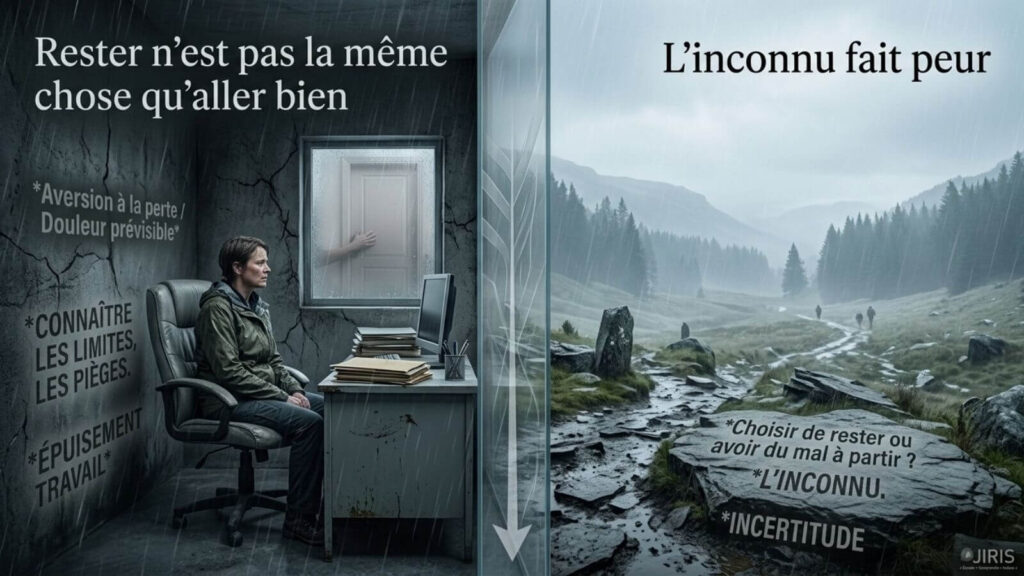
Perhaps an even more precise distinction needs to be made. A familiar situation is not necessarily one where there is no suffering—it is often one where we know how to cope with what happens to us. Pain can be predictable while still remaining pain, and this predictability sometimes provides points of reference that the unknown cannot yet offer. The problem, therefore, is not necessarily that the person prefers to suffer. It may be that they do not yet know what awaits them on the other side, nor whether they will have the necessary resources to cope.
There is therefore a significant difference between choosing to stay because one feels comfortable there, and finding it difficult to leave because the unknown is frightening. From the outside, the two situations may seem similar. They are not.
Therefore, if remaining in a difficult situation is not always a free choice, judging this immobility as a lack of will becomes both unfair and unhelpful.
When judgment adds to the difficulty
Telling someone who is already struggling that they are "staying in their comfort zone" can unintentionally imply that their difficulty isn't so real—that they could change if they truly wanted to. This message, even when spoken with good intentions, adds another layer of shame to an already burdensome situation.
However, adding shame to a difficulty is not necessarily an effective way to support change. Those who study behavioral change processes have long observed that many people who haven't yet undertaken change don't lack willpower: they simply don't feel ready yet, or they have already tried to change and become discouraged by their own ability to succeed. This apparent inaction can then be understood not simply as a refusal, but as a possible phase in a change process.

Wanting to change and being able to change now are not the same thing.
A person may very well know that a situation no longer suits them and sincerely want it to change, without necessarily possessing, at that precise moment, the emotional, material, or relational resources needed to initiate that change. Intellectually recognizing that a change would be beneficial and feeling capable of undertaking it are two distinct things.
This nuance shifts a question that would otherwise remain centered on blame: rather than asking why a person does not change, one can ask what makes this change particularly difficult for them at this time — and what they would need to consider taking a first step.
Understanding does not excuse everything.
This reflection does not mean that every difficult situation should be accepted as is, nor that the responsibility for change disappears. Recognizing that inaction has meaning does not mean that it is inconsequential, or that someone should never be encouraged to move forward.
It is possible to hold several truths at the same time: a situation can cause suffering, a person may want it to change, and at the same time, they may not yet know how to achieve this or have the necessary support to do so. These realities are not mutually exclusive.
A first step rather than a giant leap
Getting out of a difficult situation doesn't necessarily require immediate upheaval. Change often begins with a more modest step: naming what you're feeling, asking for help, exploring an option without committing to it right away, setting a boundary. For someone who has long felt stuck, a small step can mean a great deal.
This may be what makes the expression "next step" more useful than "stepping out of your comfort zone": it belongs to the person, takes into account their reality, and does not require knowing in advance the whole path to be taken.

A question to keep with you
The next time a behavior—ours or that of a loved one—seems to stem from a simple refusal to "step outside their comfort zone," a question can help clarify things: am I truly seeing their comfort, or merely their inertia? And what if what appears, from the outside, to be a comfort zone is actually a familiar zone of discomfort—a place where one endures, rather than a place where one rests?
This question doesn't prevent us from encouraging someone to move forward. It can simply change the way we do it.
JIRIS will assist you
Our perspective on immobility deserves to be as rigorous as our perspective on change itself. Difficulty moving is not necessarily a refusal: it can also reveal a protective mechanism, a lack of resources, or a necessary step in a process that follows its own rhythm.
Our training programs encourage stakeholders and organizations to better distinguish what we observe from what we deduce, in order to better understand what can make change difficult and to support people without adding to the burden they already carry.
At JIRIS, we believe that the best solutions emerge from shared reflection. That's why our training programs don't just aim to impart knowledge: they create a space to understand the issues, question practices, and build solutions tailored to each specific situation.