Normality: an ideal… or a pressure?
What our judgments about what is "normal" reveal about our relationship to difference
In Quebec, they drive on the right. In the United Kingdom or Japan, they drive on the left. The same activity—driving—follows different rules depending on where you are. What is "normal" here is not normal elsewhere, not because the action is inherently good or bad, but because the context makes it appropriate or dangerous.
Similar variations can be observed elsewhere. The physical distance considered comfortable in conversation varies considerably across cultures—what seems like normal proximity in one context may be perceived as an intrusion in another. Ways of expressing grief can also vary considerably across cultures and communities: what is perceived as an appropriate expression in one context may be interpreted differently in another. And within the same city, sometimes even within the same family, what is expected of one generation is no longer expected of the next.
This is obvious and simple. Yet it is often forgotten as soon as we apply it to anything other than distant examples — as soon as it concerns our own emotions, our reactions, our way of being.

A necessary warning
It would be too simplistic, however, to conclude that all norms are equal, or that nothing is truly "abnormal." Some rules exist precisely to allow people to live together safely—driving on the same side of the road is one example. This text does not seek to dissolve the idea of norms altogether. Rather, it seeks to distinguish between two things often conflated under the same term: a functional norm, which protects, and an identity-based or behavioral norm, which primarily describes what is customary in a given context—without the customary necessarily being healthier, truer, or more valid than anything else.
The same behavior, two different judgments
Let's take a concrete example. French work in social psychology has examined the representations linked to wine consumption and has shown that the same behavior can be judged very differently depending on the context in which it occurs: consumption perceived as problematic when it takes place alone can be perceived as normal in a collective context, even though the substance and the person remain identical.
Only the context had changed: what was perceived as risky behavior in a solitary setting became an ordinary social gesture in a collective setting.
Is being normal about adapting, or about creating?
In his now classic work on the normal and the pathological, the philosopher Georges Canguilhem proposed an idea that shifts the focus of the question. For him, the question of the normal is not simply a matter of conformity to a given norm. Rather, his reflection invites us to consider a person's capacity to cope with changing situations and to establish new relationships with their environment.
From this perspective, normality is not a stable state that we reach once and for all. Rather, it is a dynamic equilibrium, constantly renegotiated in response to what happens to us.
This idea becomes particularly relevant when observing people going through difficult times. Faced with upheaval—whether it be bereavement, trauma, illness, or a profound breakup—old ways of functioning are no longer sufficient. The individual must then, often unconsciously, invent new ways of being, feeling, or protecting themselves. What those around them or society may sometimes perceive as an anomaly is actually this vital capacity to create new points of reference to cope with a changed reality.
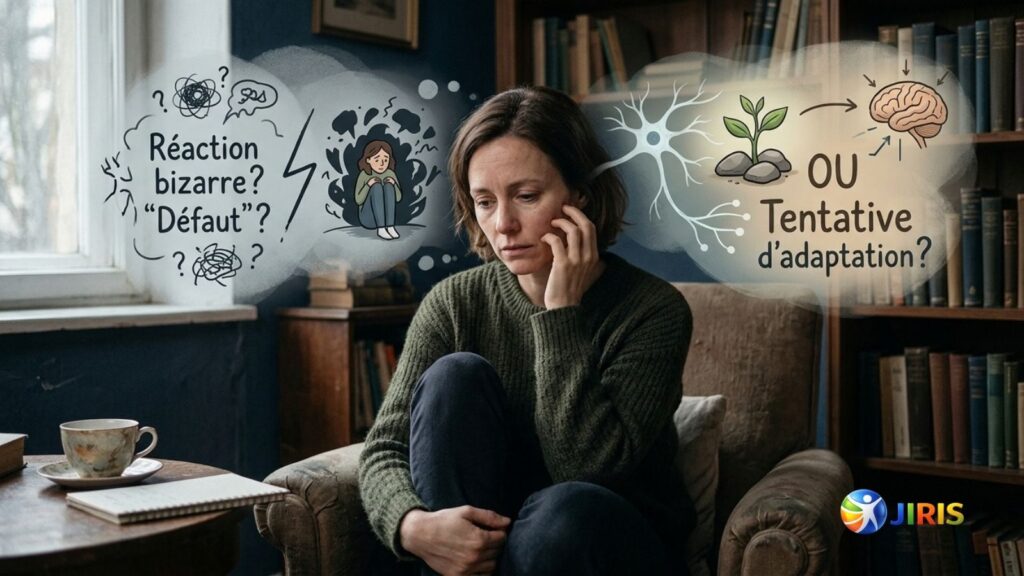
When an "abnormal" reaction is in fact an adaptation
This is where observation becomes particularly essential. A person going through a period of distress, bereavement, legal proceedings, exile, or a health crisis may develop reactions that, from the outside, seem out of the ordinary: hypervigilance, withdrawal, irritability, intense fatigue, difficulty trusting.
Human reactions, even those that seem "abnormal," often make sense within their context. This doesn't mean they are ideal or that they don't pose a problem. They can be painful, debilitating, or difficult to cope with—for the person themselves as well as for those around them. But understanding them means replacing a hasty judgment with a question: "What is this reaction trying to say?"
The problem, therefore, is not necessarily the reaction itself. It can also lie in the harsh judgment we make about ourselves or others for having had it.
"I'm not normal"
A recent study conducted with young women living with Tourette syndrome illustrates this mechanism with striking clarity. Among the themes that emerged from their testimonies, one was summed up in these exact words: "I am not normal."
These women, however, lived with a recognized medical diagnosis that directly explained their tics. This did not prevent several of them from internalizing a broader judgment about themselves — not just "I have tics," but "I am abnormal," as if the condition defined their entire identity rather than just one aspect of their reality.
It is precisely this shift that deserves to be observed: from a characteristic or a reaction, to a global judgment about what one is.
The effort to appear normal
In the field of work psychology, some researchers speak of "suffering normality": this state where, in order to continue to function according to what an environment demands, a person builds strategies to cope — at the cost of a constant effort, often invisible to those around them.
From this perspective, appearing "normal" isn't always a sign that everything is fine. It's sometimes the result of a sustained effort to hide the fact that nothing is showing. Such an effort, maintained for too long, can deplete a person's resources—to the point where they can no longer clearly distinguish what they do by choice from what they do simply to avoid being noticed.
A difference is not automatically a problem — but it can become one
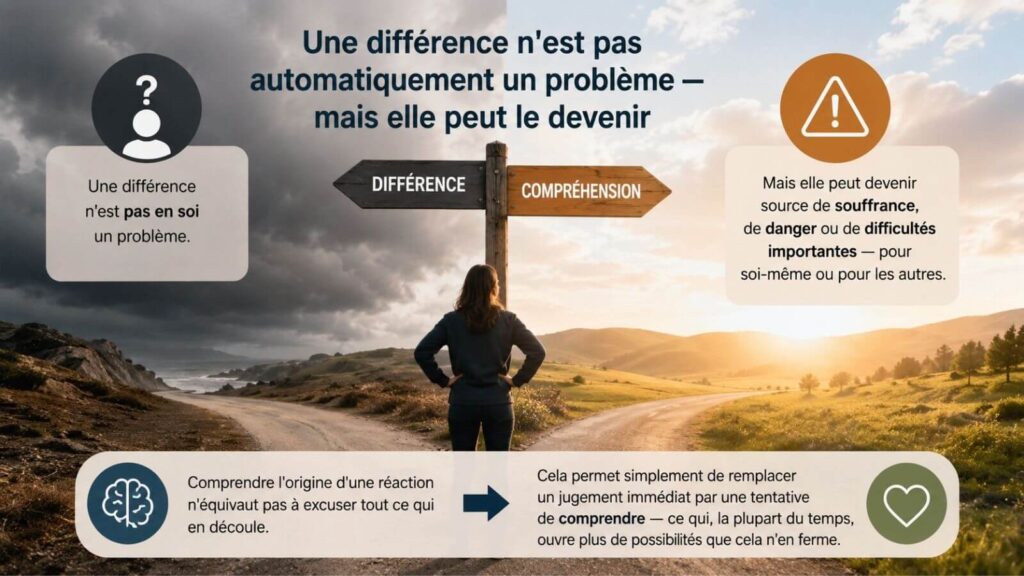
We must avoid a convenient oversimplification: saying that all differences are necessarily acceptable is also unhelpful. A difference is not inherently a problem. But it can become a source of real suffering, danger, or significant difficulties—for the individual or for others. It is then less the difference itself that deserves our attention than what it concretely produces within its context.
Understanding the origin of a reaction is therefore not the same as excusing everything that follows from it. It simply allows us to replace an immediate judgment with an attempt to understand—which, most of the time, opens up more possibilities than it closes.
Change the question
Rather than asking "is this normal?", a slightly different question can open up a more useful space: "does this make sense in this context?"
Instead of thinking, "I'm abnormal because I can't be as productive as I used to be," we can ask ourselves if slowing down makes sense after what we've just been through. Instead of thinking, "I'm overreacting, I'm weird," we can ask ourselves what this reaction is trying to signal—an unmet need, a boundary that's been crossed.
Of course, a reaction can make sense in its context and be, at the same time, statistically infrequent. One does not exclude the other.
Let's take an example. A person who has experienced an assault may develop hypervigilance: they jump at the slightest noise, avoid enclosed spaces, and have difficulty trusting others. Statistically, this behavior is rare—most people don't react this way. Yet, in the context of what they've been through, this reaction makes sense: their body and mind are trying to protect them from a danger they haven't yet fully processed.
This behavior is both rare and understandable. Recognizing it doesn't mean it's ideal or that it's not problematic—hypervigilance can be exhausting and isolating. But understanding it helps avoid hasty judgment and paves the way for support rather than condemnation.
The goal is not to say that everything rare is necessarily a valid adaptation. It is to recognize that judging a behavior solely on its rarity—without considering the context, history, and adaptive efforts behind it—is a shortcut that deserves examination.

A question to keep with you
The next time a behavior — our own or someone else's — seems "abnormal," a question can help clarify things: what criteria am I using? A local convention? A statistical average? And above all: does this judgment take into account the context, the history, and the adaptation efforts that often lie behind what we observe?
Deviating from the average is not, in itself, a reason to be ashamed. Behind this deviation, there may be a story, a context, or a way of adapting that deserves to be understood before being judged.
JIRIS will assist you
At JIRIS, we believe that inclusion is not about asking people to become "normal" in order to be welcomed. It is about creating spaces where the diversity of backgrounds and ways of being is understood first, before being judged.
Our training programs encourage stakeholders and organizations to distinguish between standards that truly protect and those that merely reflect a habit — and to examine the context of a behavior before labeling it.
The best answers emerge from shared reflection. That's why our training programs don't just aim to transmit knowledge: they create a space to understand the issues, question practices, and build solutions adapted to each reality.
To learn more
- Canguilhem, G. (1966). The normal and the pathological. Presses Universitaires de France. See the notice on Cairn.info
- Dejours, C., Abdoucheli, E., and Jayet, C. (1994). Treatise on the Psychopathology of WorkParis: Presses Universitaires de France.
- Lo Monaco, G., Piermatteo, A., Guimelli, C., et Ernst-Vintila, A. (2011). Using the Black Sheep Effect to Reveal Normative Stakes: The Example of Alcohol Drinking Contexts. European Journal of Social Psychology, 41(1), 1–5. https://doi.org/10.1002/ejsp.764
- Coleman, J., et Melia, Y. (2023). Me, My Tics and I: An Exploration of Self-Identity and its Implications for Psychological Wellbeing in Young Women with Tourette’s Syndrome. Journal of Developmental and Physical Disabilities. https://doi.org/10.1007/s10882-023-09911-x